The Dead Sea Scrolls
The most exciting discovery in the last century was the discovery of the Dead Sea Scrolls. No one has expected that ancient documents would last that long in this part of the world. But in the spring of 1947 a Bedouin shepherd boy missed one of his goats. While searching for it he threw a stone into a hillside cave and heard something broke. He summoned his assistant and found some pottery jars. Inside the jars were leather scrolls. They did not know what it was and sold them. This was at Qumran, north west of the Dead Sea. Eventually archaeologists heard about the find and recollected over 400 scrolls. Through the years archaeologists came across more rolls at Qumran and today the famous Isaiah Scrolls was discovered here to. 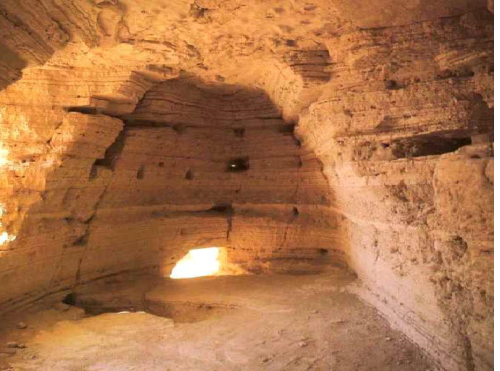
All these scrolls belonged to a "library" of a religious commune at Qumran at the edge of the Dead Sea. Their owners had hidden it in caves when the Roman army advanced against rebel Jews in 68AD. Today we know that the dry heat at the Dead Sea preserved the Scrolls. The Scrolls were written in Hebrew or Aramaic and brought new information about the Jewish religious life to light in the time of Jesus. The Old Testament books were the favorites in the "library". Most of the books are there and some are nearly complete in comparison to the Old Testament of later times. Before this discovery the earliest books available dated back to 900AD. The Scrolls was current in the first century AD.
Today this community who lived her at the Qumran is considered to be a sect. Commentators explained some of the names, places and customs that were revealed through this find. This community believed the prophets and spoke about them. The leader disagreed with most Jews of that time about the dates of major festivals and withdrew from Jerusalem to set up this strictly ruled community at the Qumran. Their enemies were called the "sons of darkness" and they considered themselves to be the "sons of light". They were looking forward to the day when God will send the Messiah and lead them to a great victory over their opponents and enemies. Their hopes were disappointed when Romans came and broke up the commune.
Until 1947 the oldest Hebrew manuscripts of the Old Testament dated from the ninth and tenth century AD. They were copies of the first five books of the Bible - The books of Moses - or also known as the Pentateuch. Then the Dead Sea Scrolls were discovered which belonged to this group of people who flourished at the Dead Sea in the time of Jesus. Amongst the books find so far are a copy of the Old Testament excluding Ester. These manuscripts are very important because they have essentially the same text as the ninth century manuscripts. It shows that the text of the Old Testament did not change for a thousand years. The copyists made very little errors or alterations. At some places different names, different places and different expressions were used. But today we can be confident that the Old Testament of today is the same as the authors wrote it many centuries ago. I am referring to the Hebrew text only as there are many errors between language translations of today.
The Qumran Ruins became famous through this discovery and the site were escavated from 1949 to 1967. This discovery was also important for the study of the early years of Christianity.
Today the Dead Sea Scrolls are displayed in a unique construction in Jerusalem. This construction is part of the Israel Museum and the construction is called "The Shrine of the Book". The Shrine shelters and displays a unique collection of ancient documents, which were discovered since 1947. One of the finds was a fragment, which contained parts of John 18 in the New Testament. The Bedouin boy found seven scrolls. An archaeologist bought three and the other four found their way to the U.S.A. In 1955 the outstanding four were bought and united with the first three scrolls. The original seven which were discovered in cave I can be seen at "The Shrine of the Book" in Jerusalem. The most popular books judged by the number of copies found of each were Isaiah, Psalms, Deuteronomy and Genesis. One of the Scrolls of Isaiah is 24 feet long and 10 inches high is the largest and best preserved of all the scrolls. The other Scroll of Isaiah contained the first 37 chapters, which were badly disintegrated, and chapters 38 to 66 were in a fair condition.
Frequent ask Questions.
What are the Dead Sea Scrolls?
The Dead Sea Scrolls are ancient manuscripts that were discovered between 1947 and 1956 in eleven caves near Khirbet Qumran, on the northwestern shores of the Dead Sea in Israel.
1. How old are the Dead Sea Scrolls?
The Dead Sea Scrolls date from the third century BCE to
the first century CE. Their chronology is anchored in historical, paleographic, and linguistic evidence, corroborated firmly by carbon 14 datings.
2. On what material have the Dead Sea Scrolls been written on?
The majority of the scrolls are written on parchment, but there are also some texts written on papyrus. Some were written on leather.
3. Which scroll is the longest?
The Temple Scroll. Its present total length is 8.148 m. The overall length of the scroll must have been at least 8.75 m. The vast majority of the scrolls survived as fragments, from which scholars managed to reconstruct approximately eight hundred and fifty different manuscripts of various lengths.
4. In what language have the scrolls been written?
The majority of the scrolls are written in Hebrew, but there are also texts in Aramaic and in Greek.
5. Who wrote the Dead Sea Scrolls?
Most scholars believe that the scrolls formed the library of the sect (the Essenes?) that lived at Qumran. However, it appears that the members of this sect wrote only part of the scrolls themselves, the remainder having been composed or copied elsewhere.
6. What kind of text are the Dead Sea Scrolls?
The manuscripts fall into three major categories: biblical, apocryphal, and sectarian. The biblical manuscripts comprise some two hundred copies of biblical books, representing the earliest evidence for the biblical text in the world. Among the apocryphal manuscripts (works that were not included in the biblical canon) are works that had previously been known only in translation, or that had not been known at all. The sectarian manuscripts reflect a wide variety of literary genres: biblical commentary, religious legal writings, liturgical texts, and apocalyptic compositions.
7. Where are the Dead Sea Scrolls now?
The majority of the scrolls are housed in Israel (eight manuscripts at the Shrine of the Book and all others at the Rockefeller Museum, Jerusalem). There are also some texts in Jordan and Europe.