Hanukkah - God's Miracle of Light
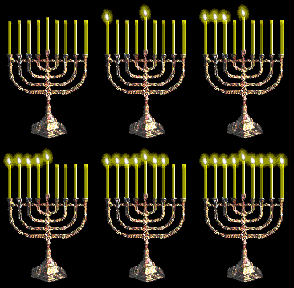
Hanukkah is the season of another biblically-connected holiday. Holidays are the stuff of memories, reinforced by sights, sounds, good food and delicious smells. They are times when family and good friends gather to celebrate and share the event together, even making new memories. Certainly, God is not one to be left out of the celebration.
His miracles are commemorated in the many festivals He initiated and described in the Bible, such as, Passover, Pentecost, and Tabernacles. However, one festival, Hanukkah, which commemorates a fantastic miracle of the Lord, is not directly described in the Bible because it occurred after the Old Testament canon was closed. Nevertheless, its celebration was incorporated into the calendar, and it was even celebrated by Yeshua (Jesus).
Hanukkah, meaning dedication, is also called the Feast of Dedication. It is a post-biblical holiday which commemorates the Maccabean victory over the Syrians in the year 165 BC. At this time, the Temple in Jerusalem was rededicated after it had been defiled by the pagan tyrant, Antiochus IV, king of Syria when he slaughtered a pig on the altar of God to mock Him and the faith and worship of the Jewish people.
When the Maccabean (Jewish) rebels arrived to purify the Temple, a day’s supply of sacred oil for the Temple lampstand miraculously lasted for eight days. Therefore Hanukkah is also called the Feast of Lights. Since the days of Judah Maccabee, Hanukkah has been celebrated by the lighting of candles for eight days as a reminder of the miracle. A special candelabra is used, called a Hanukkiah, which has holders for nine candles. One candle is called the shamash, or servant candle, and is used to light the others: one on the first night, two on the second night, and so on throughout the week. In Israel, youthful runners still carry the flaming torch from the area where the Maccabees lived near Modiin, to Jerusalem. At Jerusalem, the giant Hanukkiah at the Western Wall is set ablaze. (The variety and the design of Hanukkiot is only limited by the imagination of the designers.)
This festival is extremely popular with children because along with the lighting of candles, there is singing, the giving of a small gift each night, while partaking of special foods, and the playing of the dreidel game. Special Hanukkah foods are eaten, which are fried in oil, to remind us of the miracle oil that burned for eight days. These include potato pancakes, called latkes, and jelly donuts covered with powdered sugar, called sufganiot. Our girls, Ashley and Allison love both, especially the sufganiot! Hanukkah songs are sung, such as Maoz Tsur (Rock of Ages), which praises God for His power over the enemies of Israel. Psalms 113 to 118, the great Hallel, are read and special blessings for the miracles are recited.
A unique Hanukkah game, called the dreidel, uses a special top with four Hebrew letters on four sides, the Nun n, Gimmel g, Heh h, and Shin c. These letters are interpreted as the initials of the phrase, Nes Gadol Hayah Sham, meaning "A great miracle happened there." (In Israel, the phase reads, Nes Gadol Hayah Po "A great miracle happened here - n - g - h - p.") The top is spun, and depending on the letter showing on the upright side, the winner gets a piece of candy to sweeten the evening.
Is Hanukkah For Christians?
While Christians are often unfamiliar with Hanukkah because it is not a biblical holiday, it was, nevertheless, a holiday celebrated by Yeshua. John 10:22 states, "Then came the Feast of Dedication at Jerusalem. It was winter, and Jesus was in the Temple area walking in Solomon’s Colonnade. The Jews gathered around him saying, "How long will you keep us in suspense?" "If you are the Messiah, tell us plainly." We have read the biblical, historical accounts of other biblical feasts, and are therefore more familiar with why they are celebrated.
However, since the historical account of Hanukkah is not in the Bible, I want to share this fantastic story in more detail. Then, we can draw some lessons from the story’s themes of dedication and light.
The Bible vs. the World’s System
The story of Hanukkah occurred because of a Syrian-Greek leader named Antiochus IV. He was probably one of the most anti-Jewish, anti-Israel, anti-God rulers in history. There were several Syrian kings named Antiochus. This one chose the title, Epiphanes, to distinguish himself. This is greek for "God Manifest," which indicates the extent of his arrogance against the one God of the Bible. Antiochus’ opponents mockingly referred to him as Epimanes, meaning "madman," in response to his cruelty.
Antiochus IV came on the scene in 175 BC. He worked to strengthen a waning Selucid empire by imposing the Greek culture more vigorously, especially upon Israel and the people of God in the cruelest of manners. This pagan culture arrived into the region with Alexander the Great 170 years earlier, but its enforcement was more or less optional until Antiochus IV went on his campaign to eradicate Judaism and replace it with Hellenism. After his death, his son, Antiochus V, with his regent, Lysias, continued his father’s fight against the Maccabbees, until the Maccabees finally won the war.
Zechariah 9:13 speaks of the sons of Zion being stirred up against the sons of Greece. Return to your fortress, O prisoners of hope; even now I announce that I will restore twice as much to you . . . I will rouse your sons, O Zion, against your sons, O Greece, and make you like a warrior’s sword. (Zechariah 9:12-13.) This conflict between the Hebrew and Greek cultures still continues in the 20th century, even in Israel.
Alexander’s methods of bringing Hellenistic (Greek) culture to the conquered nations was similar to those of modern occupying forces - trade, games and cultural events which were encouraged, while many of the occupying soldiers settled down with local girls. In the beginning, the Jews were not particularly threatened by the new order. They even welcomed Alexander to Jerusalem and many male babies were named for him during the first year of his reign.
After Alexander’s death, his kingdom was divided between two of his warring generals, Seleucus and Ptolemy, into the Seleucid (Asia Minor and Syria) and Ptolemaic (Egypt) kingdoms. For more than a century, Israel was ruled by the Ptolemies who collected taxes but gave the Jews a great deal of freedom.
While strict Hellenization was not enforced in Israel, nevertheless it was gradually absorbed. While many Jews hoped for the eventual return of the Davidic Kingdom, they nevertheless dressed, spoke, ate, behaved and thought like Greeks. However, living in two worlds is never easy and the Jewish community became divided between those who accepted assimilation and those who feared and opposed it. This is still true today among Jews, and also Christians, who struggle to maintain their biblical values in the face of a very materialistic and even seductive Western culture that tries to compromise these values.
Then the political fortunes changed and the Syrian Seleucids came to power. Rome was beginning to threaten Greek rule and the Seluecids tightened up the control of their empire. Antiochus IV (Epiphanes) came to power and erected statues of himself and Zeus in Israel, banned circumcision, observance of Shabbat and the study of Torah.
What Actually Happened in 165 BC?
Let’s listen to what Josephus, the 1st century AD historian, had to say about Antiochus Epiphanes: King Antiochus returning out of Egypt, for fear of the Romans, made an expedition against the city Jerusalem; and when he was there, in the hundred and forty-third year of the kingdom of the Seleuciade, he took the city without fighting, those of his own party opening the gates to him.
And when he had gotten possession of Jerusalem, he slew many of the opposite party; and when he had plundered it of a great deal of money, he returned to Antioch.
Now it came to pass after two years, that King Antiochus came up to Jerusalem, and, pretending peace, he got possession of the city by treachery: at which time he spared not even those that admitted him into the city, because of the riches that lay in the Temple; but led by his covetous inclination (for he saw there was in it a great deal of gold, and many ornaments that had been dedicated to it, were of very great value). And in order to plunder its wealth, he ventured to break the treaty he had made.
So he left the Temple bare, and took away the golden candlesticks, and the golden altar (of incense), and table (of shewbread), and the altar (of burnt offering); and did not abstain from even the veils, which were made of fine linen and scarlet. He also emptied it of its secret treasures, and left nothing at all remaining; and thus cast the Jews into great lamentation, for he forbade them to offer daily sacrifices which they used to offer to God, according to the law.
And when he had pillaged the whole city, some of the inhabitants he killed, and some he carried captive, together with their wives and children, so that the multitude of those captives that were taken alive amounted to about ten thousand. He also burnt down the finest building; and when he had overthrown the city walls, he built a citadel in the lower part of the city, for the place was high, and overlooked the Temple.
And when the king had built an idol altar upon God’s Altar, he slew swine upon it, and so offered a sacrifice neither according to the law, nor the Jewish religious worship in that country. He also compelled them to forsake the worship which they gave to their God, and to adore those whom he took to be gods; and made them build Temples, and raise idol altars, in every city and village [in Israel], and offer swine upon them every day. He also commanded them not to circumcise their sons, and threatened to punish any that should be found to have transgressed his injunction. He also appointed overseers, who should compel them to do what he commanded.
And indeed there were many Jews who complied with the king’s commands, either voluntarily, or out of fear of the penalty. But the best men, and those of the noblest souls, did not regard him, but did pay a greater respect to the customs of their country than to the punishment which he threatened to the disobedient; on this account, everyday they underwent great miseries and bitter torments: for they were whipped with rods and their bodies were torn to pieces, and were crucified while they were still alive and breathed: they also strangled women and their sons whom they had circumcised, as the king had appointed, hanging their sons about their necks as they were upon the crosses.
And if there were any sacred book of the law found, it was destroyed; and those with whom they were found miserably perished also. Instead of intimidating the persecuted into silence, it served to unite the different factions of the Jewish community. Martyrdom inspired others to greater loyalty.
Some Faithful Jews Fought Back
This was a time of great darkness in Israel, both physically and spiritually. Antiochus sent his Greek-Syrian soldiers throughout the countryside, setting up altars and holding official ceremonies which included the sacrifice of pigs, a ceremony which mocked Jewish practice and was abhorrent to the Jews. Then they came to the village of Modiin, near Israel’s Ben Gurion airport, and they met resistance. The villagers assembled, including the family of Hashmon: Mattathias and his five sons, Johanan, Shimon, Judah, Eleazar, and Jonathan. Mattathias refused to kill the sacrificial pig and said, "We will not obey the law of the king by departing from our worship, either to the right hand or to the left."
Another Jew came forward and offered to perform the sacrificial ritual. Mattathias, overcome by righteous anger, pulled out his sword and killed the man upon the altar. Then he and his sons turned on the commander and the soldiers and killed them all on the spot. Mattathias cried, "Whoever is for God, follow me!" He, his sons and their supporters fled to the hill country where they became guerrilla fighters.
Mattathias died during the first year of the revolt and was succeeded by his son, Judah - known as the Maccabee, usually translated hammer. The name may also refer to Judah’s strength and persistence or to the blows he dealt to the Syrians. Or, it could be an acrostic for the scripture written on his battle banner: "Mi kamkha ba-elim Adonai" - Who is like unto Thee, O Lord? (Ex. 15:11). Down through history the family has been known as both the Hasmoneans and the Maccabees.
Soon others joined the Maccabees with a goal of liberating Jerusalem and purifying the Temple in Jerusalem for proper biblical worship. There were four major battles against the Syrians before the Temple was regained. The final battle took place near Emmaus, a town familiar to readers of the New Testament. The armies clashed at dawn and the Maccabees were victorious.
The road to Jerusalem was open to them. But their joy turned to bitterness when they saw the Temple where pigs had been sacrificed and Greek gods erected. They set to work, tearing down the pagan altars and cleansing the Temple. On the 25th of Kislev in 165 BC the Temple was rededicated. When it came time to light the great menorah only one small flask of oil could be found. They remember a commandment of God - "Command the Israelites to bring you clean oil of pressed olives for the Light so that the lamps may be kept burning." Ex. 27:20; Lev. 24:2 The oil, barely enough for one day, miraculously lasted for eight days.
The Meaning of Hanukkah
Hanukkah, meaning "dedication," has become a festival of light and freedom. Hanukkah celebrates both a military and a spiritual victory. Proverbs 20:27 says, "The spirit of man is the lamp of the Lord." In each generation God looks for men and women who will receive His light within them and let it shine out upon their world. The Maccabees believed in a God who cared for His people and who gave ultimate victory to those who put their trust in Him. Some of the family died in the conflict but others lived to re-capture Jerusalem and re-dedicate the Temple.
The events of Hanukkah took place in a time when the Jewish community had been exposed for 200 years to the eroding influence of Hellenism (the world’s system), the beginning of the battle between the sons of Zion and the sons of Greece. This assimilation almost caused their downfall. Have we Christians assimilated into our world around us, often Christianizing the ways of the world so that we are often numbed to the idolatry and wickedness it produces?
The glories of ancient Greece are long past, but the influence of Greek philosophy still infects our age. The Greek world-view glorified man and gave us gods made in the image of man. The Greek gods were mere personifications of human foibles and their relationship with man was rather like a bargaining session - an effort of each to out-wit the other. What a contrast to the God of the Bible. The Hebrew God, the God of Abraham, Isaac and Jacob, 1) existed in glory and majesty before the world began, 2) spoke and brought an orderly universe into existence, and 3) disciplined and guided His children as a good father. This God was unknown to the Greeks. He is also virtually unknown to many in our modern world.
Hanukkah should remind all God’s people, Jews and Christians alike, that we who are called by His Name, cannot hide among our pagan culture and assimilate. The battle between Zion and Greece continues on earth because it continues in the heavenlies. God looks for servants who will share His light to a dark world.
Pray that in Israel and throughout the world He will find many who will stand for righteousness when it is costly, who believe in a God who does miracles, who are willing to cleanse and dedicate their lives to His worship and service.
Would there have been a Jewish community to nurture Mary, Joseph, Zechariah, Elizabeth, Simeon and Anna if the Maccabees had not been faithful to defend Jewish life 160 years earlier? Only God knows, but it is important for us to know that our choices matter. As C.S. Lewis once wrote, "A small stone may determine the course of a great river. I may be that stone at this moment of history."
Perhaps Christians would be enriched by de-emphasizing the Santa Claus myths and spending some time this holiday season telling the real-life story of the Maccabees along with the miraculous birth of Yeshua, who came into the world to bring the ultimate Light.
Dedication and Light
The events of Hanukkah took place after the close of the Hebrew canon, which occurred about 430 BC. However, the word Hanukkah appears frequently in the Hebrew Scriptures, in various forms. It is used to describe the first use, the initiation, inauguration or dedication of a house, an altar, or the tabernacle and the Temple. It is found several times in Numbers 7, which is the appointed reading in synagogue services during this festival. The chapter tells of Moses and the leaders of Israel anointing and consecrating the tabernacle and its furnishings. The word Hanukkah is used of the dedication of the altar in Solomon’s Temple, II Chron. 7:9, and of the dedication of the Temple and the wall in Ezra and Nehemiah.
The verb form of the word also means to instruct or to train up. The Hebrew word is hanach Þnj meaning to narrow or to discipline. It is used in Proverbs 22:6, Train up a child in the way he should go, when he is old he will not depart from it. So one lesson we can draw from these passages is that a person who believes that his body is the Temple of the Holy Spirit, who is dedicated to the Lord’s service, will also prepare himself through instruction and training to walk in God’s ways.
Secondly, I want to look the theme of light. It is often mistaken by some Christians that Hanukkah is the Jewish alternative to Christmas. There really is no historical connection. However, thematically, there is the connection of light. Hanukkah dispels the darkness of the evil world created by pagans who hated God, and tried to thrust their evil ways upon Israel and the Jews. What dispelled the darkness is symbolized by a little light in a lamp that God kept burning for eight days. This miracle inspired and galvanized the people to finish the job that Judah Maccabees began. Christmas, which celebrates an event that occurred about 165 years later, is when God sent His Son into the world as a light to dispel the greater darkness out of the entire world. In the beginning was the Word, and the Word was with God and the Word was God. In Him was life and that life was the light of men. The light shines in the darkness, but the darkness has not understood it (John 1:1,4-5).
Scripture uses the terms "light and darkness" to refer to that which is "good and evil". Scripturally, the battle lines have been drawn between the two, both physically and spiritually. We need the spiritual discernment of the Maccabees and the courage to stand firm in our resistance to the world’s efforts to dilute our faith and the practice of that faith. If we are faithful, the light of God will shine through each of us to dispel the darkness encroaching on the world around us.
With appreciation from: