The Parable of the Prodigal Son
Scripture: Luke 15:11-32
A. Information.
The parable of the prodigal son is perhaps the best known and most popular of all the parables in the Bible. This parable appears only in the Gospel of Luke 15:11-32.
This is the last of the three parables in this chapter. Jesus told these three parables in response to the Pharisees and scribes grumbling against Him for sitting with sinners.
The first deals with a lost sheep, the second with a lost coin, and the third is the parable of the prodigal son. This is actually two parables combined in one - the parable of the younger son and the parable of the older son.
What is the meaning of prodigal? It comes from the Greek word diaskopiz? - "scatter, disperse" and in our passage means "waste or squander". Jesus is telling a story about a father who has two sons.
B. Introduction.
Jesus uses the analogy of the prodigal son in an effort to open their minds and hearts to the concepts of sin, confession, repentance and the wonderful love that God has for all of us. He was referring to his audience. Jesus knew his audience very well and understood exactly what would appeal to them. This is a made-up story but a story with some lessons for us today.
Jesus did not say what the outcome of the story was. By leaving the story unfinished, Jesus implied that the outcome was wide open.
C. Summary of the Prodigal Son Story.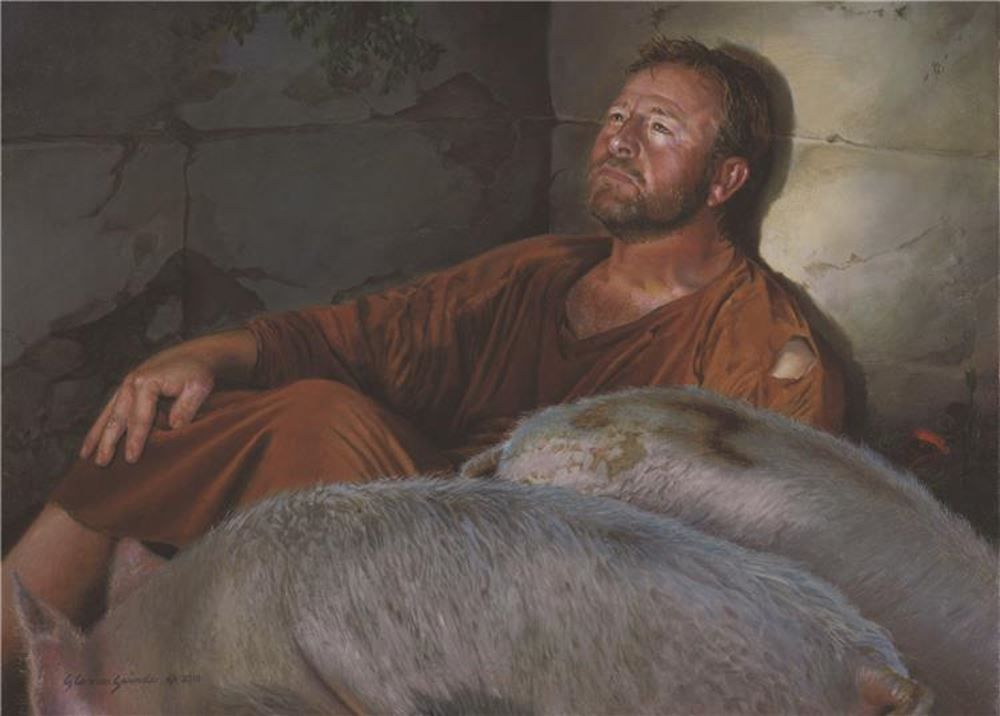
2015 - 1. The Down Fall - Luke 15:11-16
2015 - It is a story of a father who has two sons. The younger son left his father's house.
2015 - He was looking for freedom and fell into sin which ruined his life in a far country.
2015 - V11 - Status
2015 - V12 - Self-will
2015 - V13 - Selfishness
2015 - V13 - Separation
2015 - V14 - Spiritual Destruction
2015 - V15 - Self-abasement
2015 - V16 - Starvation
2015 - It showed us the destruction path of sin !
2015 - 2. The Rising-Up - Luke 15:17-24 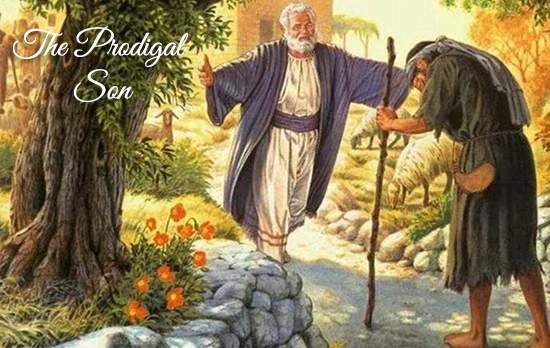
2015 - Then the son came to his senses and decided to return home to his father.
2015 - He could not wait to ask his father for forgiveness.
He is welcomed home by his father
2015 - who received him with open arms. He is restored in his position in the family.
2015 - V17 - Realization
2015 - V18 - Resolution
2015 - V19 - Repentance
2015 - V20 - Return
2015 - V20 - Reconciliation
2015 - V22 - Re-clothing
2015 - V23 - Restoration
2015 - V24 - Rejoicing.
2015 - It showed us the complete cycle of redemption of a son of the Father who fell back into sin.
2015 - Paul even responds and shows the wonderful blessing that comes to the reconciled "backsliders". (Romans 5:1-10)
D. Jesus tells the Parable of the Prodigal Son
There are three main characters in this parable of Jesus.
2015 - D1. The Younger Son
201520151. He Left the Family Home - Luke 15:11-13a
The younger son is represented as restless and impatient.
20152015a. The younger son asks his father to give him his portion of the inheritance "now".
20152015b. Since there were two sons, the younger son would receive one-third.
20152015c. The younger son intended to leave the family.
20152015d. The younger son desired to be free from parental restraints.
20152015e. The father grants him his request and gave him his portion of inheritance.
20152015f. He was not fulfilling his obligations to work for this share.
20152015This was a serious breach of the Jewish family tradition.
201520152. His Life in a Distant Country - Luke 15:13b-16
20152015a. From his actions it is clear that he had already made that journey in his heart.
20152015b. His departure was a display of disobedience to all the goodness his father had.
20152015c. The younger son travels to a distant country
20152015d. The younger son squanders all his inheritance losing everything.
20152015e. This is followed by a natural disaster in the form of a famine..
20152015f. He hires himself out to a Gentile and finds himself feeding pigs,
20152015g. He must have been very desperate to take such a degrading position.
20152015h. He was paid so little and grew so hungry that he longed to eat the pig's food.
20152015i. He could find no mercy among the people. Nobody wanted to help him.
20152015Apparently, once his wealth was gone, so were his friends. 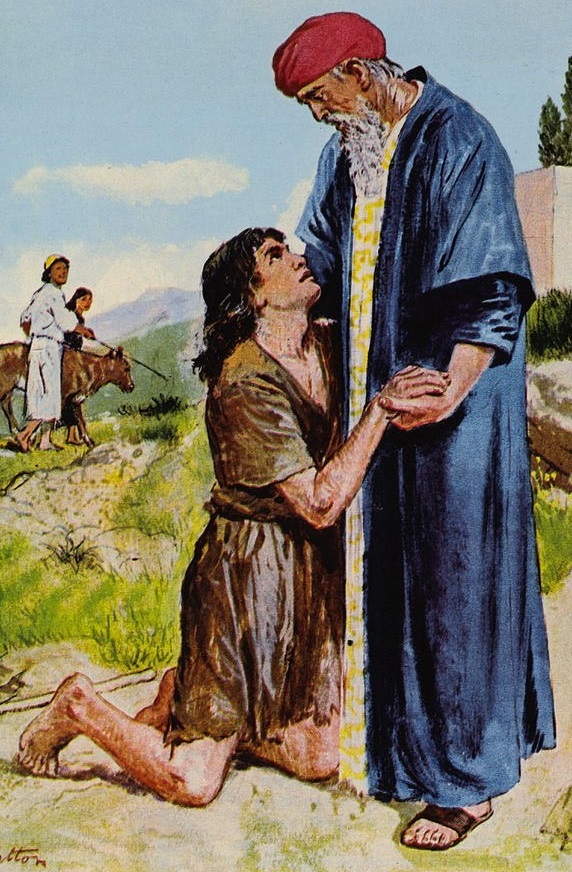
201520153. His Turning Point - Luke 15:17-19
20152015a. He came to his senses
20152015b. He recalls how well fed were his father's hired servants
20152015c. His painful circumstances help him to see his father in a new light.
20152015d. He realizes his errors and decided to repent in his heart.
20152015e. He rehearsed his little speech to his father.
20152015f. He decided to return home and face humiliation.
201520154. His Return Home - Luke 15:20-24
20152015He receives a warm welcome from his father.
20152015a. He is determined to carry out his resolution and returns home.
20152015b. The father sees him a great distance away.
20152015c. The father's great love is immediately evident.
20152015d. The son quickly confesses his sin and his unworthiness to be called his son.
20152015e. Before he can say his request to be a servant for his father,
20152015his father joyfully calls upon his servants to:
20152015201) Bring out the best robe and put it on him
20152015202) Put a ring on his hand,
20152015203) Sandals on his feet
20152015204) Kill the fatted calf
20152015f. The big celebration starts
2015 - D2. The Father
20152015a. The father was wealthy and a loving person.
20152015b. The father loves both sons
20152015c. He left the house to greet both the sons
20152015d. He calls both his own sons
20152015e. He gave both their rightful inheritance although only one asked for it.
The father grated his son's request and gave him his portion.
20152015I think the father was not happy to see his son leaving. The father waited patiently for his son to return.
20152015f. The father's great love is immediately evident when he sees his son in a distance.
2015201520i) He has compassion
2015201520ii) He runs to greet his son
2015201520iii) He throws his arms around his son's neck
2015201520iv) He kisses him
2015201520As the son returned the father rushes out to meet him, welcome him with his open arms.
2015201520He also shielded him from rebuke and shamefulness.
20152015The son confesses his sin and acknowledges that he had lost the right to his sonship.
20152015g. He shows his forgiveness receives him back into fellowship.
20152015h. He shows his generosity and immediately makes him feel at home:
2015201520i). The best robe - traditionally reserved for guests of the highest honour.
2015201520ii). The ring - signifies authority and a return to his position as his son.
2015201520iii). The sandals - indicate that he was a free man. Slaves and the poor went barefoot.
2015201520iv). A fatted calf is slaughtered - enough for a big celebration feast for the whole community.
2015 - D3. The Elder Son - Luke 15:25-30
20152015A. Older Son's Reaction.
2015201520a. The elder son, returning from the field, wonders what the celebration is about
2015201520b. When told by one of the servants, he become angry and refuses to join the party.
2015201520c. His position is soured by his envious attitude.
2015201520d. The father comes out, and pleads with him to join the celebration.
2015201520e. The father answers gently:
2015201520"My son, . . . you are always with me, and everything I have is yours. But we had to celebrate and be glad" (verses 31-32).
20152015B. The Elder Sons Response.
20152015The older son's words and actions reveal several things about him:
20152015201) The elder son complains and is spiteful in his response:
20152015202) His words were sharp, bitter and he shows no respect towards his father.
20152015202a) He does not recognize the younger one as his brother
20152015202b) For many years he had served his father and sees himself as a slave.
20152015202c) He never disobeyed a commandment from his father.
20152015202d) He accuses his father of never giving him a young goat.
20152015202e) The father had never provided such a celebration for him
20152015202f) He implies sexual immorality on the part of his brother, to belittle him.
2015201520These words must have grieved the father as much as the first son's leaving years ago.
20152015C. The father's Response to his elder son
2015201520a) He answered him tenderly - (addressing him as "child")
2015201520b) He recognizes the elder son's faithfulness (you are always with me)
2015201520c) He re-assures the son that the remaining inheritance is his (all that I have is yours)
2015201520d) The father maintains that it is right to celebrate. (your brother... )
2015201520e) He corrects his son - the elder son had called him "this son of yours".
2015201520f) The father emphasizes the brotherly relation,
2015201520"your brother ... was dead and is alive again, and was lost and is found." (repeating what was said before in Luke 15:24)
E. Key Words and their meanings.
There are three main characters in this parable, the father, prodigal son and elder son.
1. The Father represents God - The Father.
It is a story of a forgiving and loving father and is a picture of God, the Father.
2. The Prodigal son represented the social outcasts, in need of God. The prodigal son represents the sinfulness tax collectors and the backsliders.
3. The Elder son represents the self-righteous.
The older son represents the self-righteous, Pharisees and teachers of the law.
Jesus identifies Himself with God in His loving attitude towards the lost.
It reveals more about the love of the father than of the sinfulness of the younger son. The parable also reveals much about the heart of the unforgiving elder son.
F. Spiritual Meaning of this parable.
This parable illustrates the nature of God's forgiveness and the joy in repentance and reconciliation. The father represents the FATHER in Heaven.
The younger son represents those who came to their senses and returned to God. God the Father is a patient God and waits for our return.
The elder son does not understand grace and has no room for forgiveness and represent those still living in darkness. The elder brother reflected the attitude of the self-righteous like the Pharisees and scribes.
a. God's love for all sinful man.
b. God's desire to save us.
c. The desire of our heavenly Father that the sinner repent (2 Peter 3:9)
d. There is "joy in heaven" when the sinner returns.
e. We have an inheritance in God.
G. Key Lessons for Us to Learn from this parable.
1. We can see what sin is.
2. We can see the destructive nature of sin.
3. We can see the power to change a person's life.
4. God will forgive the sinner who returns to Him.
5. We need to forgive other sinners who return home.
H. Spiritual Meaning of the Parable of the Prodigal Son.
1. The Prodigal son.
The younger son in the parable learned the hard way that covetousness leads to a life of dissatisfaction and disappointment. He also learned that the most valuable things in life are the things we cannot buy or replace. He is a rebellious believer who has returned to a life of sin. The results of sin are never pretty. It is all about the younger son's journey from prideful rebellion to humble repentance. The younger son is met with his father's unconditional love and forgiveness which symbolizes God's grace.
The younger son experience restoration and reconciliation. He was not expecting this.
2. The Father.
But the father's love is the main topic of this parable. Just as the father loved his disrespectful son and longed for his return, God loves all sinners and waits patiently for them to repent and return to His love and protection. Just as the father rejoiced when his son repented, God rejoices when a lost sinner repents. Just as the father forgave his son and welcomed him back with full status in the family, God will forgive sinners and welcome them back with full status in the kingdom of God.
What a picture of God's love, condescension, and grace!
God's heart is full of compassion for His children; He stands ready to welcome the returning sinner back home with joyous celebration that is what God's grace does for a sinner. Not only are we forgiven in Christ, but we receive the Spirit of "adoption to sonship". We are His children, heirs of God and co-heirs with Christ.
3. The Older Brother.
The older son represents people who are self-righteous and critical of others. The older son had been loyal to his father his entire life. He was also disrespectful to his father and resented the mercy his father extended to his brother. The older brother felt cheated because he had lived in obedience to his father but never received any reward like his youngest brother. His focus was on himself and his own service; as a result, he had no joy in his brother's arrival home. He was so consumed with justice and equity (as he saw them) that he failed to see the value of his brother's repentance and return. The older brother had allowed bitterness to take root in his heart to the point that he was unable to show compassion toward his brother. The bitterness spilled over into other relationships, too, and he was unable to forgive the perceived sin of his father against him. Rather than enjoy fellowship with his father, his brother and the community, he stayed outside the house and refused to join them.
I. Contrast between the two brothers.
There is a clear contrast between the two brothers. We read about the younger son's behavior before and after he returned. We see the attitude of the older son's behavior and attitude towards his father and brother. The father loved both sons.
The younger son, who squanders his inheritance and returns home in repentance, is met with his father's unconditional love and forgiveness, this symbolize God's grace.
The older son, who adheres strictly to duty and obedience, reacts with bitterness when his father celebrates the return of his brother (the prodigal son), reflecting a legalistic mindset that values merit over mercy.
Not only is there a message for all of us in the Prodigal son but also a great message for us in the behavior and attitude of the elder son in this parable.
J. Meaning of the Gifts to the Prodigal Son.
The father commanded his servants to bring five items. 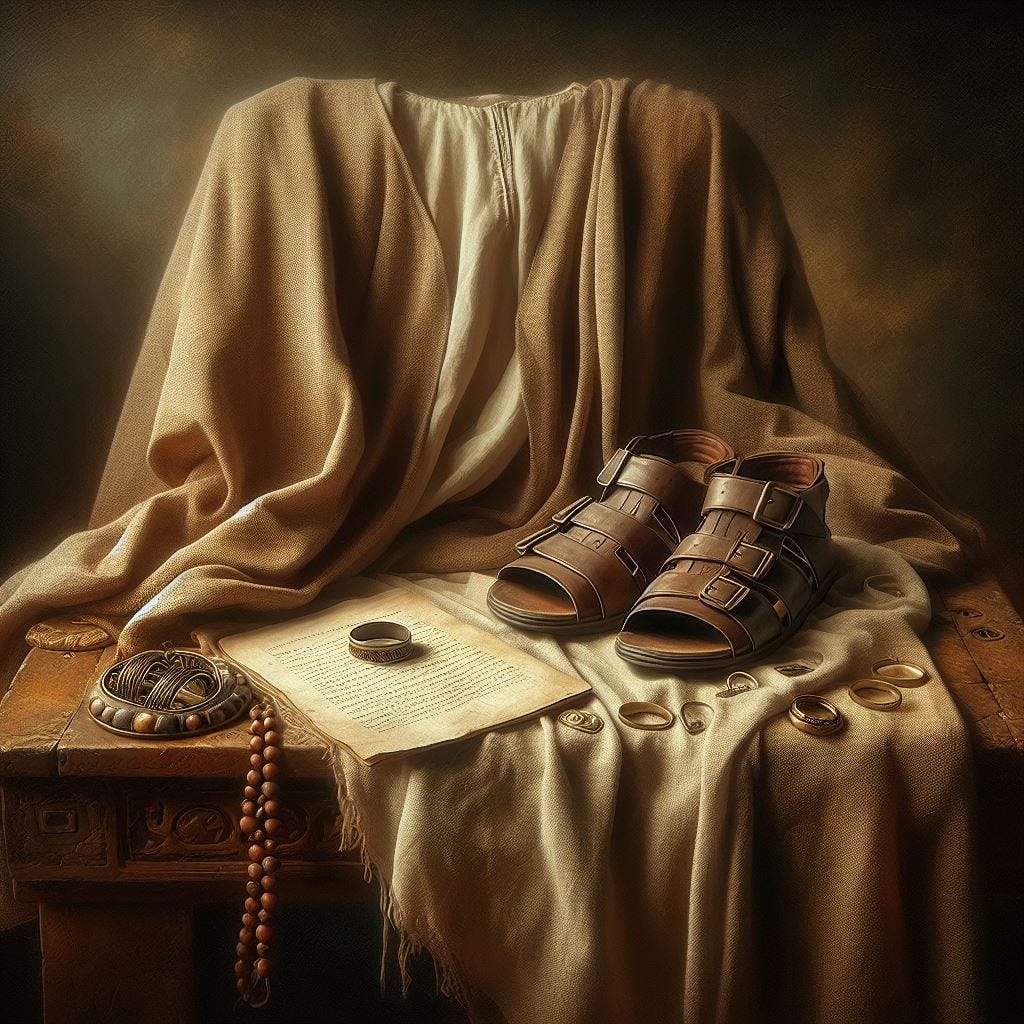
1. A Robe.
He put the finest robe on his returned son is a sign of dignity, respect and honour. It is proof of the prodigal's acceptance back into the family. This kind of love brings great acceptance, healing, and renewed purpose.
That robe represents the robe of righteousness provided through the shed blood of Jesus Christ. It is the garment that God covers each of us with so that when he looks at us, He only sees us washed in white and as His child. "Our sins He remembers no more."(Hebrews 10:17) That robe is what symbolizes us as acceptable and justified - "not guilty" before the Lord.
2. A Ring
Then the father put a ring on his finger. The ring is a sign of authority and sonship. A ring is symbolic of authority, honor, and covenant. It is the granting of authority to a person. He has authority to make decisions and to help the master govern his realm. And when the father places the ring on the hand of his son, he welcomes him back to responsibility and authority."
It is also a symbol of a covenant between the father and the son. When we accept Jesus we are also in covenant with Him and the Father. God has given us as believer in Christ authority and dignity. Because of the Cross we are born again into the family of God. That ring is a picture of our sonship and authority in the kingdom of God.
3. Sandals.
The sandals for his feet show us the father cared for his son's needs. The father is offering son-ship and freedom. This refers to his new life with his family. For us as believers, this refers spiritually to our holy life walk now that we accepted the Lord.
4. The Fatted Calf.
The father knew that his son was hungry so he provided food for him. The father orders the fattened calf to be prepared, and a party is held in honour of the returned son. Fatted calves in those times were saved for special occasions. The fatted calf was the sacrifice. Jesus willingly laid down His life for our sake.
5. Celebration Feast.
The final gift given to the son was the feast and celebration. Notice that they have the calf killed before the celebration. This is a picture of Jesus on the cross. Now because he died that we may live, we can celebrate this restored relationship with God. There is a celebration when we remember the cross. The feast is a picture of what occurs in heaven over one repentant sinner (Luke 15:7+10) who returns to the Father. It is recorded twice in this Chapter.