The Parable of the Weeds
Scripture: Matthew 13:24-30 and 36-43 (NIV)
The Parable is in Matthew 13:24-30. Jesus gave the explanation in verses 36-43.
A. Introduction.
The parable of the weeds was told to a multitude by Jesus. He only explained it to His disciples. This title reveals the focus of this parable. It is about the kingdom of heaven, but the emphasis is on the role of the weeds in the kingdom.
Jesus begins to use the example of a farmer to explain what the kingdom of heaven is like. 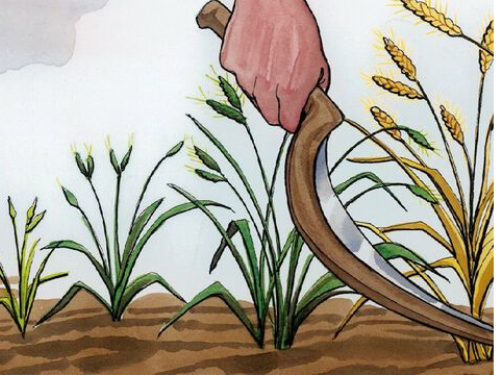 Such an illustration fitted since farming was a common occupation and the people could relate to the practices of farming. The farmer in this parable sows only good seeds in his field.
The one who sows the good seed also owns the field. It is "his" field. Then, we are told that "the field is the world" (Matthew 13:38). So this sower of the good seed is the owner of the whole world.
In this parable, the word "weeds" (tares) is translated from the Greek zizania, which refers to "a troublesome weed in the grain fields, resembling wheat."
This plant has the appearance of wheat and grows exclusively in cultivated fields. The "tares" or "weeds" represent a plant which we call today a "darnel." It is a poisonous plant which looks very much like wheat. When it first starts to grow it is difficult to distinguish it from wheat. But as it grows, it begins to change. When it is harvest time, it can easily be identified as tares (weeds) and looks different than the wheat. It is also interesting that the seeds of the darnel plant (Lolium temulentum) contain a poisonous drug that can be fatal.
This parable followed the parable of the sower (soils). I was wondering why it did not follow the parable of the dragnet as the stories are much similar. So maybe the reason is that it was associated with a farmer as it followed the parable of the sower.
B. Key Terms and their meanings.
The phrase "sows good seed" refers to preaching the Gospel. By doing so, Jesus is spreading the word of God and planting the seeds of faith in people's hearts. The "good seed" represents those who receive and accept the message of the Gospel, and as a result, become followers of Christ.
1. Sower - Son of man (37).
Jesus commonly described himself as the "Son of Man." By tying the "man who sowed the good seed" with the "Son of Man," Jesus is emphasizing His role as the saviour of humanity and the one who spreads the Gospel to all who will listen.
2. Field - world (38).
The field is the world. In this parable, Jesus uses the metaphor of a farmer sowing seed in a field to explain the nature of righteousness in the world. Jesus emphasizes that the field in this parable refers to the world. Within this vast field, both good and evil coexist. The devil and his followers are present alongside those who belong to God's children. This is similar to the tares growing with the wheat, where both plants grow together until the time of harvest.
3. Good seed or wheat - sons of kingdom of heaven (24).
Jesus plants in all of the world people and welcomes them as, "sons of the kingdom" (v.38). The good seed represents righteous people who are sown into the world.
The good seeds are the sons of the kingdom. The kingdom's children, who are also known as "God's people", hold a special place in the King's heart. They are considered the heirs of the kingdom. The kingdom of heaven has been specifically prepared for them. These children of God are the result of His tireless efforts and represent the very fruit of His labour.
They embody the purest qualities of goodness, kindness, and compassion which make them the perfect recipients of His eternal kingdom.
The Son of Man (Jesus) devoted His life to spreading the gospel, which He did by sowing the good seed.
This seed, which represents His teachings, was meant to be carried across the world and shared with all those in need of salvation.
4. Weeds - "son of the evil one" (38).
The weeds represent also people who are sons of the devil. The tares, or weeds, are the sons of the wicked one. Those who reject the teachings of Christ are often referred to as the "children of the wicked one." These individuals are believed to belong to the devil who embodies his nature in their thoughts, words, and actions. They are considered to be diametrically opposed to those who have accepted Christ and are said to be living in a state of spiritual darkness. The children of the wicked one are those who have refused to be born again in Christ and who have instead chosen to follow their own desires and inclinations.
They are said to be under the dominion of satan and to be constantly at odds with the followers of Christ. Jesus Himself is believed to have offered only two choices to humanity: to accept Him as the Son of God and to follow His teachings or to reject Him and embrace the path of darkness.
Those who choose the latter are said to be in rebellion against God and to be destined for eternal separation from Him.
5. Enemy - devil (39).
The devil is the one who deceitfully works in the darkness among the people of the world to undermine and destroy the work of Jesus. The enemy is satan, the devil.
The devil is always looking for opportunities to obstruct God's work. He is constantly trying to thwart Jesus' mission. The devil preys on the weak and vulnerable, always looking for the right set of circumstances to take advantage of someone and lead them away from God. Despite the devil's efforts, Jesus' teachings continue to inspire millions of people around the world, giving them hope, guidance, and a sense of purpose in life. It is through Jesus' message of love, forgiveness, and compassion that people are able to find meaning in their lives and connect with God on a deeper level.
The devil, who is always looking for ways to sow seeds of evil and sin, plants his seeds among the ones that Jesus has planted. He does this under the cover of darkness when the watchmen, who are supposed to guard the field, are at their weakest and asleep. The devil knows that his seeds will grow alongside Jesus' seeds, and he hopes that they will intertwine and take root in the hearts of the people.
6. Harvest - refers to the end of the age (39).
The Church age will end. The harvest is at the end of the age. The farmer in the parable waits until the harvest time to uproot the weeds and sort them out from the good crops. In the same way, at the end of the age, Christ will come to judge the living and the dead, and to separate those who genuinely believed in Him from those who did not. This judgment will be the ultimate reckoning, where the rebellious people will be utterly destroyed, and the righteous will enter into life, while the wicked will receive everlasting punishment.
The judgment day will also be the day when the earth, and all that is therein, and the unrepentant sinners will receive the punishment they deserve. This parable serves as a reminder to live a life of faith and trust in Christ, who will come again to judge the living and the dead.
7. Harvesters (reapers) - angels (39).
There really are angels, mighty spiritual beings, who are the servants of Jesus, helping Him to do His will.
The harvesters (reapers) are the angels. In Matthew 13:28-29, the servants found weed amongst the wheat. They were facing a dilemma. Then they asked a question: should we gather up the weeds that have grown among the wheat? Note: In ancient times, it was common for people to sow weeds in the fields of their enemies as a way of spoiling their crops. This meant that it was necessary to regularly check the fields and remove any weeds that had grown to prevent them from damaging the wheat.
The farmer responds to their question by cautioning his servants not to uproot the wheat along with the weeds while collecting them. The farmer is essentially saying that it's better to allow the weeds to grow alongside the wheat until the time of the harvest, at which point they can be separated without causing any damage to the wheat. Later Jesus explains that the reapers who will harvest the field are His angels.
This is a reference to the final judgment when the righteous and the unrighteous will be separated, with the former being gathered into the Kingdom of God and the latter being condemned.
Jesus chose His angels to harvest and separate the weeds and the wheat. Ultimately, it is God who will judge the living and the dead, and His angels play an essential role in carrying out His divine will.
8. Barn - The barn is the future manifestation of the kingdom (30).
Jesus explains that they will shine in the kingdom of their Father like the sun.
This means that not only will they be allowed to enter the kingdom of heaven, but they will also shine brightly as children of God the Father.
The idea of shining like the sun is a metaphor for being fully realized and glorified in the presence of God.
The New Testament is very clear that the only way to enter this kingdom is through faith in God's Son, Jesus. His death on the cross pays the price for the sins of those who trust in Him, and they are given credit for His righteous life and entrusted with good works to carry out. This is called imputed righteousness and it means that believers are credited with the righteousness in Christ.
9. "He who has ears, let him hear"(42)
This phrase was used during this time to get people's attention to important teachings.
At the end of the explanation, Jesus warns everyone to pay close attention to what He has said and to apply it in their lives.
Jesus emphasizes that it is not enough to simply hear the message, but it must be understood and applied in one's life.
C. Spiritual Meaning of this parable.
There is similarity between the kingdom of darkness and the kingdom of God. Our Lord gave the interpretation of this parable to His disciples in secret because it is truth that only those who are truly born again can understand. The Lord reveals this truth to His disciples that they might learn about things that have been hidden for ages.
This parable tells us about the counterfeits to true Christianity in the world and what the final outcome will be for these false or counterfeit christians. This parable also gives us a glimpse into the future and what will happen in the end of times.
The fate of those who reject the message is described as being thrown into the outer darkness where there will be weeping and gnashing of teeth. This is a metaphor for eternal separation from God and the suffering that results from that separation.
Jesus omits some details in His explanation to the disciples (36-43):
20151. He did not mention that the enemy came while people were sleeping.
20152. He said nothing about the gathering of the wheat into the barns.
20153. He did not mention the burning of the weeds in fire.
Maybe these details were ignored to focus attention on the deeper significance of the parable - the battle between good and evil, between God and satan.
In conclusion, the parable emphasizes the importance of faith in Jesus Christ and the rewards that come with that faith. Those who trust in Jesus are declared righteous and enter into the kingdom of God where they will shine like the sun. However, those who reject Jesus will suffer the consequences of their rejection.
D. Application - Lessons for us.
Knowing from the parable that good and evil are to co-exist until the end of the age can help us make some practical decisions.
1. Continue to tell about the good news.
This parable tells us that the sons of the kingdom and the sons of the devil cannot be distinguished until the end of this age. Therefore, we are to preach the Gospel to all indiscriminately.
2. Continue to grow in Christ.
We still have a chance to grow spiritually in Christ. We all have a calling and a purpose which God have planned for us. Bloom where you are planted.
3. Practice Tolerance.
The command in the parable is specifically to leave the tares and the wheat to grow together. We must not try to disobey this. This reinforces the idea that it's better to wait until the appropriate time to separate the good from the bad, rather than rushing to take action that could cause unintended harm.
Always remember, the mission of the church is sowing seeds not pulling weeds.
We have a big enough challenge on our hands trying to deal with sin in our own hearts, our own families, and our own churches. It is not in our power or in our calling to root it out in the world. That is the work of Christ and he will do it when he comes.
4. Stay alert - The battle continues
"Jesus said that while they were sleeping, his enemy came and sowed weeds among the wheat, and went away." This is referring to believers and the Church. Many were asleep and are still sleeping. It is time to wake up and see what is happening. The enemy succeeded in many ways. Wake up Church, Wake up!
The enemy will try his best to try to deceive you. We need to be aware of this. He always acts when we are not alert. We are to appeal to the Word of God to discern between true and false teaching, and, thus true and false teachers.
5. Be Patient with Others.
This parable should teach us not to condemn others. We cannot see people hearts.
So while it may seem like God is not doing anything about unbelievers, remember that we were once unbelievers also. Just as God was patient with us, we should be patient also.
6. Only two kingdoms.
We know that this parable is about the sons of the kingdom, also known as the kingdom of light, true Christians, and the devil's sons, also known as kingdom of darkness, growing and living together in this world until the end of the age.
There are only these two groups. You either belong to the one or the other (Colossians 1:13 Amplified). There is still time to accept Jesus as your Savior. Do not delay it.
7. Responsibility of Teachers or Preachers.
Preachers have a great responsibility to look after their flock. They should also make people aware of the consequences if they are in rebellion against God and do not accept His forgiveness for them.
8. Sanctification and Fear of the Lord.
2015A. Sanctify in the Hebrew means: to consecrate, sanctify, prepare, dedicate, be hallowed, be holy, be sanctified, be separate.
2015B. Sanctify in the Greek means:
2015 - 1. to render or acknowledge, or to be venerable or hallow, to separate from profane
things and dedicate to God -
20152015a. consecrate things to God
20152015b. dedicate people to God
2015 - 2. to purify -
20152015a. to cleanse externally
20152015b. to purify by expiation: free from the guilt of sin
20152015c. ally by renewing of the soul See Ephesians 5:26 and John 17:17
9. Anticipate being part of the Harvest
Then the righteous will shine like the sun in the kingdom of their Father (Matt 13:43). God will harvest the wheat and will bring His people home, the righteous will shine like the sun.
May you be found in the bundle of life with the people of God who submit their lives to King Jesus and stand before the Father in the grace that they find in Him.